How Do You Treat a Hyperextended Wrist?
Call (817) 382-6789 to have this looked at, or book online with Dr. Knight.
A hyperextended wrist, also known as a sprained wrist, is a common injury. It’s difficult to gauge how common wrist sprains are because many go undiagnosed. A minor wrist hyperextension will typically heal on its own with minimal treatment. However, if you’re in extreme or ongoing pain, you should see your health care provider for a detailed diagnosis.
What Is a Hyperextended Wrist?
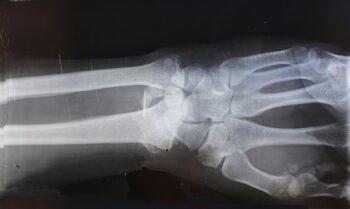
x-ray result by Cara Shelton is licensed under Unsplash License
A hyperextended wrist occurs when the wrist is sprained, typically due to falling on an outstretched hand. The impact causes the wrist to bend backward, stretching the ligaments too far. This may result in either a small tear or a complete tear of the ligament. Hyperextension typically impacts the scapholunate ligament, which sits between the scaphoid and lunate bones in the wrist.
Grades of Hyperextension: Severity Levels Explained
There are three grades of hyperextended wrist injuries, and the severity of the sprain determines the appropriate treatment plan.
Grade 1
A grade 1 wrist sprain is a mild injury where the ligaments are stretched but not torn. Symptoms may include mild pain, tenderness, swelling, or slight bruising around the site of the injury. You can still use your wrist with a grade 1 sprain.
Grade 2
A grade 2 wrist sprain occurs when you have a mild tear in the ligament, but it’s not completely torn. This type of sprain causes notable pain and tenderness that may persist even when the wrist isn’t in use, as well as swelling and bruising. A grade 2 sprain compromises the stability of the joint, so you may find it difficult to use your wrist.
Grade 3
Grade 3 sprains are the most severe form of wrist hyperextension and involve a complete tear of the ligament. The ligament may also pull away from the bone. This type of injury causes severe pain, swelling, tenderness, and bruising. With a grade 3 sprain, you won’t be able to use your wrist as usual, as both stability and range of motion are impacted. You should seek medical attention immediately for a grade 3 wrist sprain.
Comprehensive Treatment Options
If you have a hyperextended wrist, your doctor will perform a physical examination and test your wrist’s stability and range of motion. An MRI scan may be useful with a grade 2 or grade 3 injury, as it can provide more detailed information about the state of the tendons and cartilage. If you’ve suffered from a grade 3 sprain, your doctor will probably order an X-ray to determine whether you’ve suffered a bone fracture along with the hyperextension.
Initial Care Strategies: The RICE Method
The RICE method is the recommended first response for a hyperextended wrist or any type of soft tissue injury, particularly within the first 24 hours. RICE stands for:
- Rest: Avoid using your wrist for at least 24 hours following the injury or longer if pain and swelling persist.
- **Ice:**Apply ice or a cold compress to the injury in 10-minute intervals to relieve pain. This makes the blood vessels constrict and briefly numbs the injured area.
- Compression: Wrap the wrist in a compression bandage to help minimize swelling.
- **Elevation:**Keep the wrist above the level of the heart as much as possible to slow blood flow to the area and help minimize swelling.
Nonsurgical Treatments: Splints, Physical Therapy, and Medications
If the RICE method isn’t sufficient to relieve pain and tenderness in your hyperextended wrist, you may need to incorporate other treatments as well. Kinesiology tape can help relieve pain by providing added support as your ligaments heal. Your doctor may also recommend a wrist splint for additional stability. Always speak with a health care provider before using a splint to assess the extent of the injury.
Nonsteroidal anti-inflammatory drugs, such as Aleve, Motrin, and Advil, may help control pain and swelling associated with wrist hyperextension. If you need to take these medications long term, you should discuss the proper dosage with your doctor.
As your wrist heals, you should restore motion gradually and mindfully. Speak with your health care provider about physical therapy exercises that you can do to restore strength and range of motion in your wrist. Your physical therapy regimen may include:
- Wrist flexion: Bending the wrist downward
- **Wrist extension:**Bending the wrist backward
- **Radial deviation:**Rotating the wrist toward the little finger
- **Forearm pronation:**Rotating the forearm with the palm facing downward
- **Supination:**Rotating the forearm with the palm facing upward
When Surgery Is Necessary: Indications for Surgical Intervention
Surgery for a sprained wrist is rare and typically occurs only with grade 3 injuries. In such cases, surgery may be used to reconnect the ligament to the bone with a tendon graft. This procedure may be performed either arthroscopically, with a small incision and camera, or through open surgery, where the injury is exposed.
Recovery Process and Timeline
A grade 1 wrist hyperextension will typically heal in one to three weeks, while a grade 2 injury usually takes three to six weeks to heal. In contrast, a grade 3 wrist hyperextension may take several months to heal. If you have wrist surgery, the ligament itself will usually heal in eight to 12 weeks, but it may take six to 12 months for the wrist to heal completely.
Contact the Hand and Wrist Institute for Help With a Hyperextended Wrist
If you suspect that you’ve suffered from a serious hyperextended wrist injury, our team at The Hand and Wrist Institute in Texas can help. We can provide an expert diagnosis and treatment plan to help address your immediate pain while working toward restoring strength and range of motion. Contact us to schedule an appointment.