Rehab Routines for Wrist Injury Recovery
Call (817) 382-6789 to have this looked at, or book online with Dr. Knight.
A wrist injury can make daily activities like cooking, working, or hobbies harder. Rebuilding strength requires patience and a careful recovery plan. If you’re recovering from an injury, try out these effective rehab routines to regain wrist strength after a wrist injury, with safe steps and proven exercises to restore your hand function.
Understanding Wrist Injuries
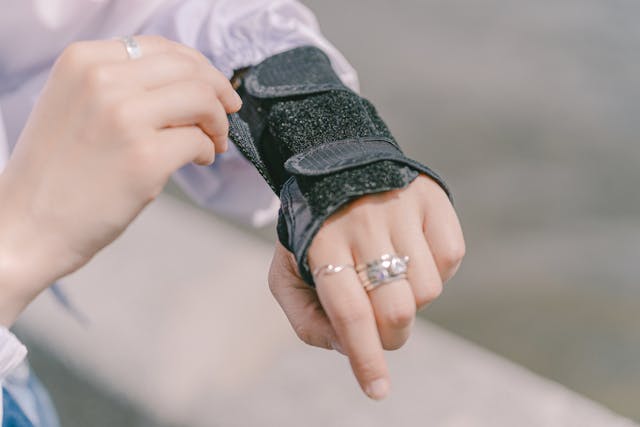
Image via SHVETS production, used with Pexels License
Woman Hands Wearing Protection by SHVETS production is licensed withPexels License
Your wrist is a complex structure that requires consistent and precise movement. It has 10 bones, 20 joints, and over 20 ligaments and tendons that work together in smooth coordination. Any sudden injury to one of these vital components can make even simple motions extremely difficult and painful.
Here at The Hand and Wrist Institute, we treat a wide variety of conditions. These include everything from general sports injuries and fractures to complex issues like arthritis or carpal tunnel syndrome. Dedicated rehabilitation is essential for returning to normal function after medical treatment.
Importance of Rehab After Wrist Injury
Restoring your wrist to full strength takes time. You can begin with gentle movements to maintain joint flexibility and support healing. Steer clear of strenuous activities to avoid scar tissue formation, which can make moving around more difficult.
Well-designed rehab routines are there to help you rebuild strength safely, improving endurance, stability, and range of motion step by step. They also help you regain the muscle support needed for everyday tasks like turning a key or lifting a cup. Completing this healing process not only enhances your physical ability but also boosts your confidence to enjoy a smoother, long-term recovery.
Preparing for Wrist Rehab Exercises
Get clearance from your orthopedic doctor or therapist before starting your rehab exercises. Exercise can harm your wrist after severe trauma or complex surgery. Your specialist can evaluate your healing and advise you when to begin controlled range of motion and light resistance training.
When rehabilitating, focus on gradual improvement rather than pain. Avoid the outdated “no pain, no gain” rule and treat recovery as flexible. Slow down if you feel sharp or intense pain in your wrist or forearm. You can then modify your routine based on how your wrist feels each day.
Core Rehab Routines to Regain Strength After a Wrist Injury
A successful rehab plan usually involves three easy steps: start with gentle joint warm-ups, then gradually add controlled resistance exercises to strengthen the muscles. Finish with relaxing deep stretches to enhance flexibility and gently cool down. Start with low resistance and slowly increase it over several weeks for the safest and most effective progress.
Range of Motion Exercises
Range of motion (ROM) exercises are a great way to warm up your body, keeping your joints moving smoothly without extra strain. Begin by sitting with your forearm fully supported on a flat table. Let your hand hang freely just over the edge of the table. Slowly bend your wrist forward (flexion) and then smoothly bend it backward (extension), holding each position for five or six seconds.
Practice moving your wrist carefully from side to side, which is known as ulnar and radial deviation. Keep these early movements slow, controlled, and well within a comfortable, pain-free range.
Strengthening Exercises
Once you start regaining your basic mobility, you can begin building your muscle strength with controlled, light weights. You don’t need any fancy gym gear. Everyday household items like a soup can, a small water bottle, or a light dumbbell work just fine. To do a weighted wrist extension, just hold the item with your palm facing down, then slowly lift your hand toward the ceiling and lower it back down.
If you’ve been diagnosed with carpal tunnel syndrome or if you suspect you have it, avoid weighted wrist flexions. This specific movement can compress the median nerve in the wrist and cause further aggravation.
Stretching Exercises
Deep stretching is vital for increasing the length of the muscles and connective tissues surrounding your wrist joint. Aim for a feeling of mild tension or a moderate stretch, but stop immediately if you experience sharp or alarming pain.
To stretch the flexor muscles on the palm-up side, hold your arm straight out in front of you and gently use your other hand to pull your fingers backward toward your body. For the extensor muscles on the palm-down side, gently pull your fingers toward your inner wrist. Hold each of these deep stretches for at least 15 to 30 seconds, repeating the movement two to four times.
Here’s a sample you can easily follow:
| Goal | Exercise Example | Load/Intensity Guidance | Frequency/Hold |
| Warm-up/mobility (ROM) | Wrist flexion and extension | Slow, controlled movement, no pain | Hold for 5-6 seconds. Repeat 8-12 times |
| Strengthening | Weighted wrist extension | Light dumbbell, soup can, or resistance band | 2-3 sets of 10-15 repetitions |
| Cool-down/Flexibility | Forearm extensor stretch | Mild to moderate stretch sensation | Hold for 15-30 seconds. Repeat 2-4 times |
Integrating Wrist Rehab Into Daily Life
Incorporating your rehab exercises into your daily routine can make a big difference in your recovery. These natural activities can improve your stability and endurance, often more than isolated weight exercises.
Simple tasks like wiping down the counter or cleaning a surface actually serve as effective therapy, engaging important side-to-side wrist movements. Try activities such as carefully scooping dry dog food, carrying a handled grocery bag, or practicing buttoning small clothes. These functional movements allow you to gradually and safely introduce your recovering wrist to all the typical physical stresses of living your life fully.
Make an Appointment With The Hand and Wrist Institute
You deserve to live without pain and get back to activities that make you happy. The Hand and Wrist Institute offers top orthopedic care in Dallas-Fort Worth, backed by over 25 years of experience. We use advanced, minimally invasive techniques to restore function swiftly and precisely. If you’re dealing with persistent pain or need a personalized plan for rehab routines to regain strength after a wrist injury, contact us now to book an appointment.