Sagittal Band Tear
Call (817) 382-6789 to have this looked at, or book online with Dr. Knight.
What is a Sagittal Band Tear?
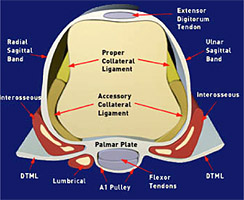
To truly understand what a Sagittal Band Tear is, a basic knowledge of hand anatomy is helpful. The hand bones (metacarpals) articulate with the finger bones (phalanges) at the metacarpophalangeal joint (MCP). The extensor tendons are thick fibrous structures that connect the muscles in the forearm along the back of the hand to the phalanges to produce movement in the fingers. Specifically, they allow the fingers to straighten or extend. The sagittal bands are ribbon-like ligaments that encircles the MCP joints to stabilize and centralize the extensor tendons during motion. Injury to the hand can result in partial or complete rupture of a sagittal band. Sagittal Band Tears are commonly referred to as “Boxer’s Knuckle” since this type of injury is common to the sport.
What causes Sagittal Band Tear?
Sagittal Band Tears often results from trauma to the knuckle, whether it be a single blow or multiple blows over time as is usually the case with professional martial artists and boxers. While much more uncommon, this injury can also occur in people with no history of trauma to the hand and in older individuals suffering from arthritis. Any activity that requires repetitive extension of the finger may lead to Sagittal Band Tears. The middle fingers are most commonly affected, followed by the little fingers.
What are the symptoms of Sagittal Band Tear?
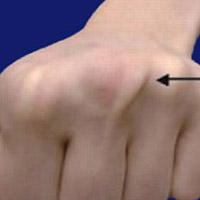
The symptoms of Boxer’s knuckle vary with the severity of the injury. In traumatic cases, patients frequently report a popping or snapping sensation along with immediate pain and edema to the knuckle. It may be difficult or impossible to fully extend the finger. When making a fist the defect can be seen and felt as the extensor tendon slides to one side of the knuckle.
How is Sagittal Band Tear diagnosed?
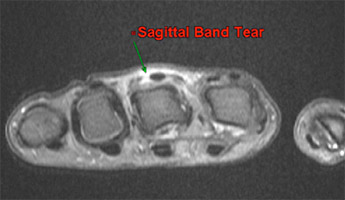
As with most injuries, diagnosis begins with a review of history and onset of symptoms. The physician will examine and manipulate the hand assessing the appearance and range of motion, as well as, the quality and degree of pain. X-rays will be used to rule out the possibility of fracture. MRI or CT scans can confirm diagnosis by visualizing the soft tissues in the hand and identifying if rupture has occurred.
How is Sagittal Band Tear treated?
Non-Surgical
Conservative treatment may be indicated in acute cases of Sagittal Band Rupture where trauma is not the cause, when there is minimal pain or loss of function and within one week of onset. The affected finger will be immobilized in an extension splint for 4-6 weeks. Additionally, your doctor will recommend pain and swelling management with ice and over-the-counter medications like ibuprofen, aspirin, or naproxen. Unfortunately, most acute and chronic case of Sagittal Band Tear will require surgery.
Surgical
Surgery may consist of either a direct repair of the sagittal band or an extensor centralization procedure when sagittal band repair is not possible. Post operatively a splint is placed for about 6 weeks to ensure proper healing and recovery. Hand therapy is then used to restore full function, strength and dexterity. Full recovery varies from patient to patient but can be expected in 5 to 6 months.
How can Dr. Knight help you with Sagittal Band Tear?
Come visit Dr. Knight, one of the most accomplished hand specialists in Dallas, Texas. See him at the Southlake office or Dallas hand and wrist center.
Frequently Asked Questions:
What is the recovery time for a sagittal band tear?
Recovery time can depend on whether surgical intervention is required for the injury, based on the extent of the condition and the mechanism of injury. In cases when trauma is not the direct cause of the injury, and the band itself is not fully separated, then conservative treatment may be enough to remedy the condition and allow the band to grow back together. This is achieved by four to six weeks of splinting and resting, as well as anti-inflammatory medication and painkillers as needed. In the case of a surgical treatment, a splint will be placed on the affected hand for a minimum of six weeks after surgery, after which occupational therapy will be necessary to return the affected limb to full capacity. This full post-surgical recovery time can be expected to last five to six months overall.
Can I treat a torn sagittal band at home?
If the sagittal band is not fully torn, then it may be possible for the condition to be treated at home with conservative methods, particularly splinting, anti-inflammatory medications, icing, rest, and possible pain relief. Unfortunately, if the tear in the sagittal band is more severe, then surgery will be the only viable option for treating the condition.
What exercises can I do for a sagittal band tear?
All exercise done in order to bring function back to a hand that has been injured, particularly in the case of a torn tendon such as the sagittal band should be done under the advisement of both a doctor and an occupational therapist. These will vary from therapist to therapist, but generally the various soft tissues of the hand will be palpated and the extent of the loss of function and range of motion will be determined, and a regimen of exercise will be decided upon. The exercises will largely focus on the flexing and opening of the fingers, as that is the mobility most affected by the injury to the sagittal band.
Videos
Disclaimer
HandAndWristInstitute.com does not offer medical advice. The information presented here is offered for informational purposes only. Read Disclaimer

This clip is age restricted on YouTube, so it cannot play here. Watching it needs a signed-in YouTube account.