Trigger Finger Surgery
The transcript below is YouTube's automatic one. Anatomy terms are the words the machine heard, so a few of them are wrong. The practice is proofreading them.
- Video ID:
FyUzORrK75g - URL: https://www.youtube.com/watch?v=FyUzORrK75g
- Uploaded: 2014-10-23
- Duration: 188s
- Views at capture: 445916
- Captions: YouTube auto-generated (no manual track published)
Description (channel copy)
http://www.handandwristinstitute.com/trigger-finger-surgery/ - Of all of the conditions that can affect the hand, trigger finger is among the most common. As with many conditions of the fingers, it is typically caused and exacerbated by repetitive activity such as typing or text messaging, although it is not limited to these activities alone. Trigger finger most commonly affects the ring finger, but it not uncommon in any of the digits of the hand, and it typified by a snapping of the finger, accompanied with pain.
Trigger finger affects the flexor tendons, which control flexion of the finger; that is to say, they pull the fingertips into the hand towards the palm. These tendons can develop nodules, or knots, which then become stuck on the pulley bands that normally keep them in position against the finger bones. In particularly bad cases, the nodules can become so large that the tendon is unable to pass through the pulley at all, making it impossible to flex or extend the finger, depending on the position when it becomes stuck.
Conservative treatment of trigger finger consists of cortisone injection, which can be an effective remedy in up to 50% of occurrences. Should this injection prove ineffective then surgery may be necessary. The procedure is a simple one, and only requires local anesthesia. A small incision is made in the affected finger(s), through which the pulley band upon which the knotted tendon is caught is sliced, freeing the tendon to return to its standard mobility. The wound is then closed and sewn shut with three to four stitches. Mobility returns to the finger almost immediately.
A light dressing will be placed over the wound, and this must be kept dry for ten days, after which time the stitches are taken out by the doctor, and light activity may be resumed. By about four weeks, any tenderness at the scar site should resolve, and full function returns. It is not uncommon to see trigger finger occur in different digits of the same hand at different times, although recurrence is extremely unlikely in the same digit.
Transcript
let's take a look at trigger finger surgery trigger finger is one of the most common conditions that a hand surgeon treats occurs most commonly from frequent uh keyboard use as you can see here frequent texting anything repetitive that causes the fingers or
thumbs to move uh can cause this problem as you can see here this is the actual Tri it's a painful triggering condition where the finger snaps back and forth ring finger most common but can occur in any digit and let's take a look at an animated anatomical picture here the
blue structures are the flexor tendons there's two to each finger and one to the thumb and they go through a little these white bands what we call pulley and it's within these bands that you get the mechanical advantage to be able to bend the fingers into the Palm as you
can see from this picture the the fingers are being bent into the palm and now as we straighten you can see again the tendons are are moving back and forth now and it when what happens is from repetitive use you get a little nodule that forms in the Palm on one of
the tendons and that nodule uh becomes larger over time from repeated friction and much like a little knot in in a rope trying to go through a pulley this nodule starts ramming into the flex into the uh flexor sheath or pulley system and it actually can grate back and forth
causing this popping of the joint just beyond that or the middle joint the finger in severe cases the finger can actually become locked straight but more commonly it's locked in a bent position now initially when the patient comes in we will do a cortisone shot effective in
about 50% of cases but you will see from an animated video here we'll actually show you the surgical procedure we make a little cut local anesthetic about a five minute outpatient procedure a little light sedation we actually cut the band that's uh impeding the tendon
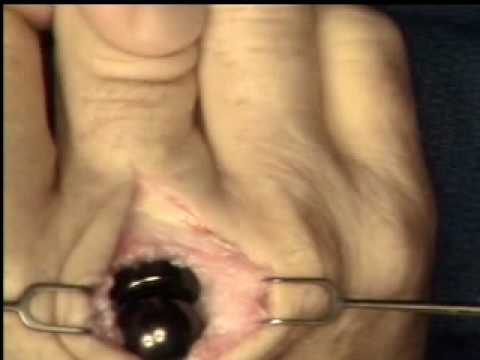
and we open that up that allows the finger to bend we Place several sutures two or three four sutures in place and a little light dressing now an actual picture or video of a of a patient undergoing this procedure you can see here putting the scissors right
underneath this white structure here the retractors are in place we're snipping with the scissors that band you can see a great picture here of that actual opening up of that band in this case of this patient she had no flexion upon releasing her tendon immediately once we
awakened her during the procedure she could bend the thumb so after the procedure it's about 10 days with a little light dressing or Band-Aid over the incision you're moving it right away uh sutur come out 10 days later and then it's about a 4- we Total Recovery just
because it's sensitive skin to place a cut on the hand so it's about four weeks give or take for the uh all the soreness to go away but activity is tolerated now there's very little chance of recurrence with this condition but what you will see it'll pop up in other fingers over
time even as several months later just from uh using the other hand or the same hand you can get you know repetitive motion and get and another one comes up for more on this condition and many other conditions visit our website at the Hanah Institute