TMC Joint Replacement Surgery
The transcript below is YouTube's automatic one. Anatomy terms are the words the machine heard, so a few of them are wrong. The practice is proofreading them.
- Video ID:
KLDb1budAVI - URL: https://www.youtube.com/watch?v=KLDb1budAVI
- Uploaded: 2014-11-02
- Duration: 285s
- Views at capture: 39726
- Captions: YouTube auto-generated (no manual track published)
Description (channel copy)
http://www.handandwristinstitute.com/joint-replacement-hands/ -One of the most common places to develop arthritis in the hand is at the TMC joint, which connects the thumb to the rest of the hand. It is also, unfortunately, one of the most physically debilitating. Forceful gripping and grasping, especially when paired with a torqueing motion of the wrist, tend to exacerbate development of injuries in this area.
Located between the trapezium in the wrist and the metacarpal of the thumb, the TMC joint is saddle-shaped, and is important in the mobility of the thumb, especially in its relationship to the fingers. Degenerative arthritis and daily overuse of the joint, which can cause the ligaments to lose some of their tautness, as well as different fractures and other forms of arthritis (inflammatory and Rheumatoid) can be contributing factors in TMC issues.
As the injury involves the bones of the wrist and hand, x-rays are the most commonly employed, and most effective, methods of diagnosing this problem.
Conservative treatment of TMC injuries is usually a regimen of rest, which should allow the joint to repair itself. NSAID anti-inflammatory medication is also effective in reducing symptoms, as well as use of a thumb spica splint while the patient is sleeping. If these prove ineffective, then a cortisone injection may be a possible treatment, but this is only if all else fails.
When symptoms continue unabated, especially when the patient is at rest, then the injury may be treated surgically. Two incisions are made over the TMC and the thumb metacarpal and the triquetrum is taken out of the joint, leaving a space. The bones are noosed together using a heavy suture through the bones, and the open space can be filled with a ball made of tendon tissue taken from other parts of the arm. New developments in procedure, however, make this generally obsolete in treatment.
Splinting for one week will be necessary after surgery, after which time a removable brace will be employed for one month. At that point, therapy will be engaged for two months, to return function to the joint.
In most cases, this surgery is 95% effective in the resolution of symptoms and return of function. Unfortunately, surgery generally does not return full strength to the joint, due to the restructuring of the joint.
Transcript
let's talk about TMC joint replacement surgery the TMC joint here at the base of the thumb is one of the most debilitating areas of the hand to get arthritis very common area that we get arthritis and this is precipitated by many daily activities that we do
day-to-day such as forcefully grasping act jars Lids Etc and removing these puts undue stress across that joint also simply opening a a a door with a key also put stress across that joint but we need to look at the anatomy to appreciate what's going on here the TMC
joint is made of the trapezium right here it's a saddle-shaped joint with the thumb metacarpal sitting on top of that it there's so much movement in the thumb that occurs through this joint that allows our thumb to oppose to all the other fingers with and the thumb is 40%
of the function of the hand so it's in this tight saddle shaped joint that over time from weakening of the ligaments from from inflammation in the joint can lead to a narrowing down or wearing down of the cartilage with wear and tear
degenerative Earth or what we call osteoarthritis that occurs as we get older now this can occur with other conditions such as inflammatory arthritis commonly rheumatoid arthritis or when there are fractures that occur into the joint at an earlier age that
just don't heal properly leading to what we call traumatic arthritis now let's look at an x-ray of this the circle is around the trapezio metacarpal joint or TMC joint and there's very little space you can see bone on bone uh uh changes occurring here as to the normal spaces
as compared to the normal spaces throughout the rest of the joint now the treatment for this initially conservative treatment is the rule anti-inflammatory medication such as ibuprofen and wearing at what we call thumb spike a brace particularly at
night to rest when you're sleeping a cortisone shot as a last resort may be beneficial but if conservative treatment fails there's a uh 40 minute outpatient surgical procedure that we do when the condition uh is is causing pain with just day-to-day activities or even pain
with at rest or pain Awakening you at night that's when you look at doing this um a little bit more extensive procedure but we go in through two incisions at the thumb and on the metacarpal base of the index metacarpal and we're going to first go in make Cuts here and over on
the base of the index metacarpal and then we're going to come in here with a little biter and we're just going to remove that trapezium bone but we have to do something to keep the metacarpal from hitting the other bones so we're going to go in here and we're going to
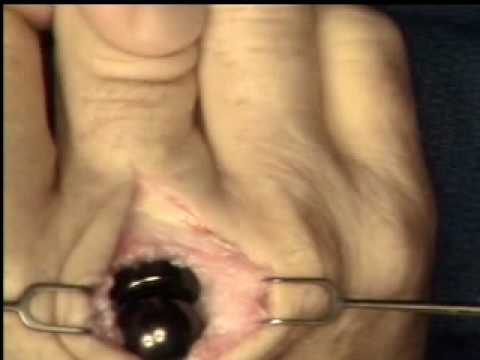
drill a hole between these two bones then we're going to take what we almost like a Kevlar type suture like a bulletproof vest it's very strong suture they're using now for ACL reconstruction shoulder reconstructions and we're going to put this has a little button metal
button at each end and we're going to tie that there and it's this button that acts like a n use to prevent this um metacarpal from hitting the next bone now some surgeons may elect to actually take an extra tendon that you have in the forearm roll this up like a little
Olive ball and place that into that space with a new tight RPP procedure though you don't necessarily have to do this in fact in many usually I don't do this and it's still just as effective so let's take a look at a posttop x-ray now this show the the arrow here shows the
open space after removing the trapezium and you can see the two buttons here that show that those are in good position you can't see the suture but there is a suture that's tethering between those two spots now after this proced after this you're placed in a
brace and after about the first week you come back we take the brace off we remove the little bandages the Stitches the sutures dissolve and then we uh place you in a removable brace and that removable brace is on or total immobilization after surgery is for
about one month and then there's about two-month therapy protocol that happens at that point all in all this is about 95% effective it's about a 3mon Total Recovery it's 95% effective at at reducing uh most of the discomfort and it gets allows preservation of of all
the movement that you had in the thumb prior to surgery the only thing it doesn't do is restore normal pinch strength but it won't hurt like it did to Grass before surgery it just is never a normal joint Point as it was uh once the arthritis occurred and it never will
be going forward but it's a highly effective surgery for more on this condition and many other conditions please visit our website